

It is undeniable that using AI tools like Claude Code lets us write code faster now.
But the question is, how does that impact everything else?
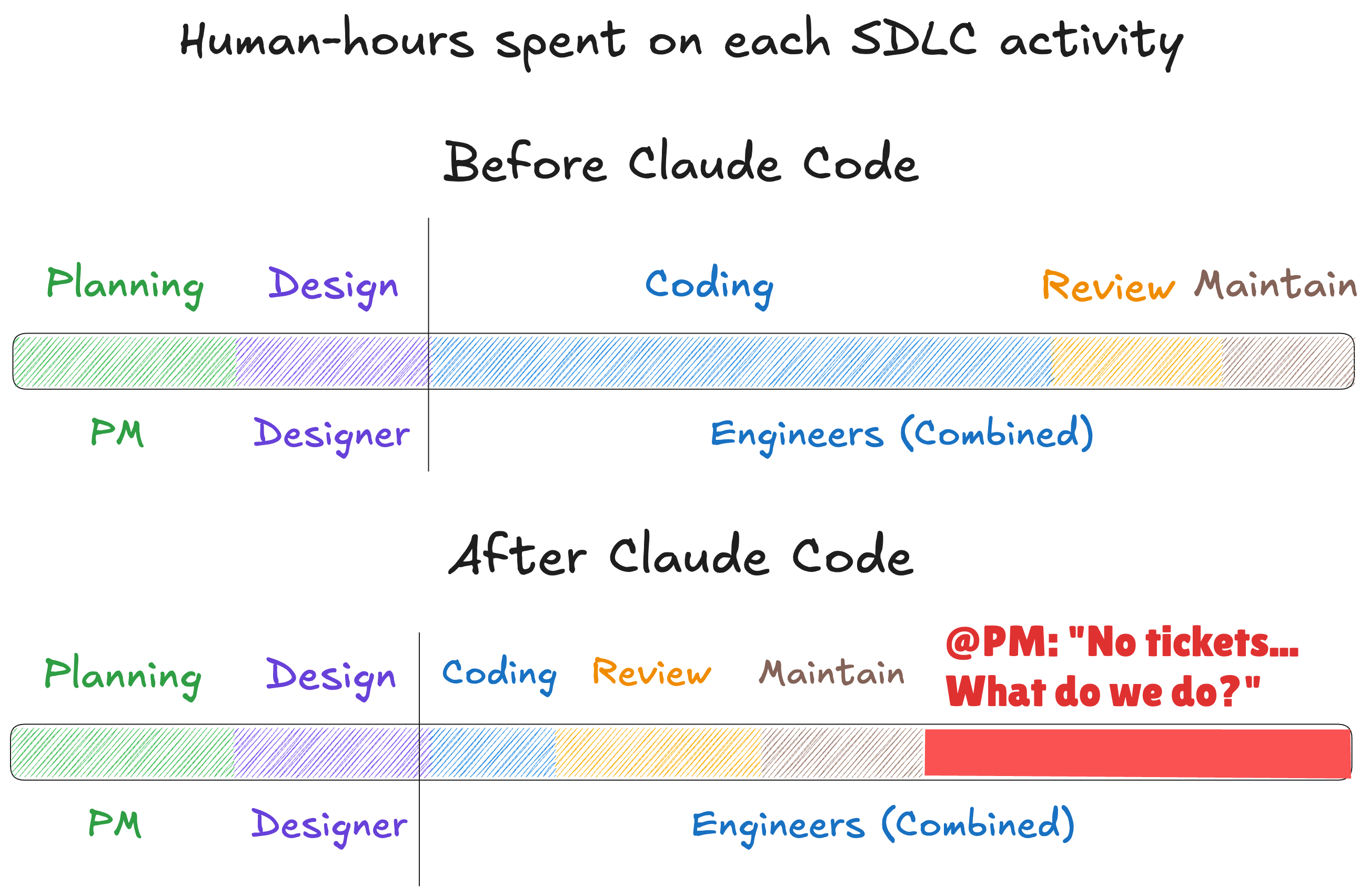
In most teams, coding - reading, writing, and debugging code - used to be the part that took engineers the most time, but that is no longer the bottleneck.
The Theory of Constraints states that every system has a bottleneck, since without one, it would operate infinitely fast, which is impossible.
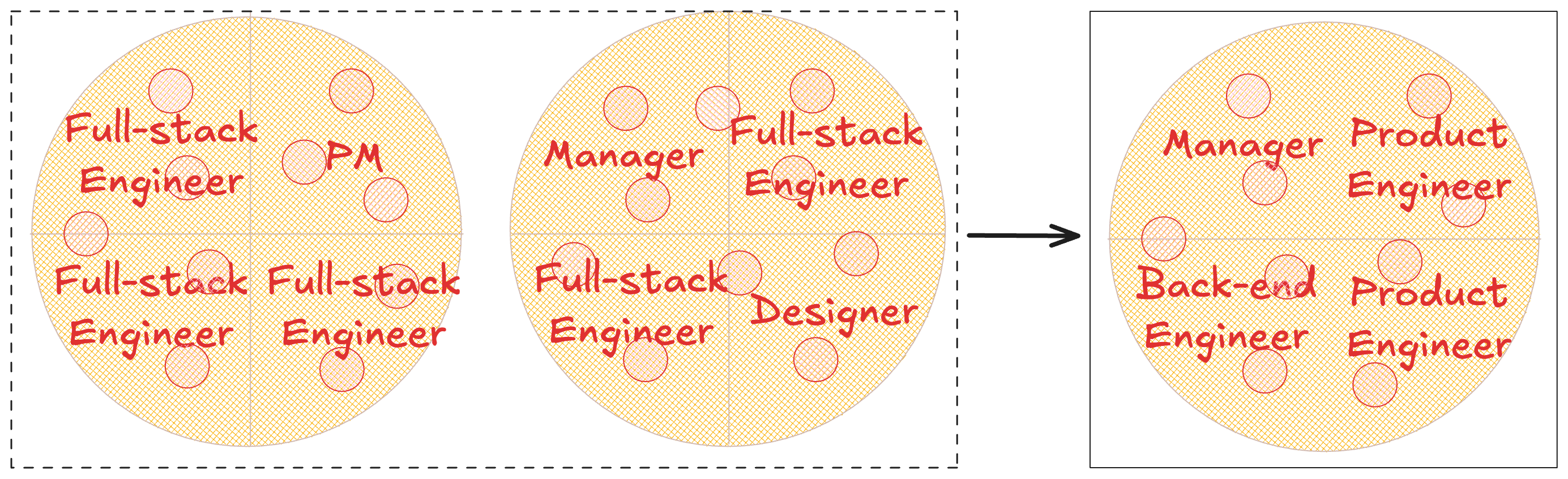
Let's see the new bottlenecks, their effect on the size and roles of engineering teams, and why Amazon's two-pizza-team rule - “teams should be small enough to be fed by two large pizzas, ideally comprising 5-8 people” - is being phased out.
Product and design are the new bottlenecks
Currently, LLMs are less useful for product managers and designers than for engineers.
On the Designer side, they struggle to create great prototypes. You notice how every AI product homepage looks the same. I believe this is a limitation of LLMs: they tend to generate ideas near the middle of their training data’s bell curve, which prevents bad design but also limits truly innovative concepts.
On the Product Manager (PM) side, LLMs can gather data and insights, but the most time-consuming part for the PM is communicating and talking with clients, which can't be automated as effectively.
This creates a new bottleneck: The project output starts to depend on the delivery speed of product specs and wireframes.
And it gets worse: generally, you have 4-7 engineers but a single (sometimes shared) PM and Designer in a team, creating an imbalance.
Sharing the Legos
Some companies recognized this imbalance and asked, “What if the engineers were involved in Product and Design instead of just receiving the product specs?” Then they started hiring Product Engineers.
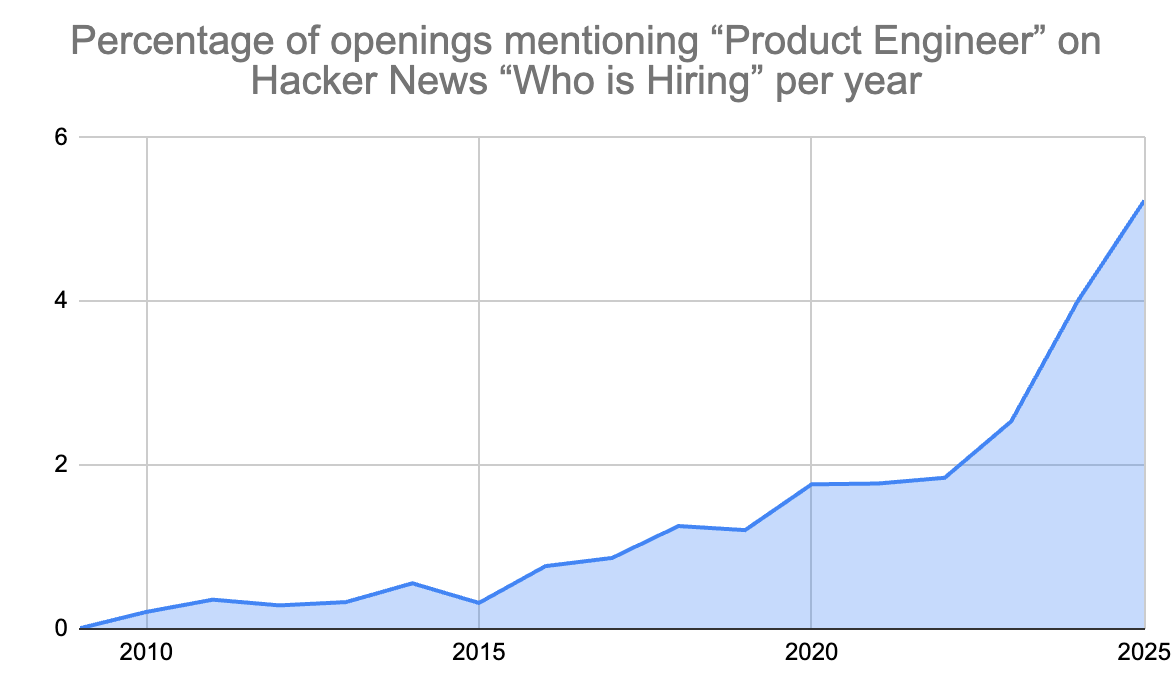
This is not a new concept; the role has existed for over 16 years. But I am highlighting this because they are now more relevant than ever.
Okay, so what are product engineers? They are software engineers empowered to handle some responsibilities of PMs and Designers, balancing the roles.
Product engineers assume traditional PM roles, including owning the roadmap, engaging with users, analyzing data, framing opportunities, and determining what to build. However, they do not replace a PM. The PM still provides context but is no longer the main driver of implementation.
On the designer side, they also assemble the building blocks of a design system. The designer still creates those blocks and collaborates on the UX flow, but they are no longer responsible for producing “pixel-perfect prototypes” that engineers must follow.
The rise of specialists
Not everyone should or will be a product engineer.
But the traditional software engineer who is "A jack of all trades, master of none" will not surpass an engineer who is a “master of one”.
AI is good at producing code of acceptable quality, but it is rarely excellent. You can't simply prompt and merge it into a mature codebase without in-depth human review.
There are many problems with AI coding:
AI often approaches coding carelessly, neglecting second-order effects: it modifies or removes essential code without considering the consequences.
For an LLM to fix bugs, they need to make sense (and for the ones that pierce through the abstraction layers, they rarely do), so you can't just have a team entirely using AI without a solid understanding of the tools they use.
AI will replicate destructive patterns in your codebase, causing a decline in code quality over time because no one will detect and fix them.
So, we need specialists to manage the platform code. It’s not that they won’t use AI, but they will act as gatekeepers during reviews and prevent bad patterns from being merged into the codebase.
We will probably see fewer full-stack engineer openings and more roles for back-end and front-end engineers. This doesn't mean they will do only one or the other, but they will be expected to be an expert in one area.
Small Teams, Big Dreams
Besides the previously mentioned imbalance, large teams also face two main challenges: communication overhead and the need to divide work so team members can work independently toward a shared goal.
For the second problem, it wasn't too bad. We could divide the work into epics that would take an engineer two weeks to finish, and they could work on them independently. But now two weeks feels like a long time.
Another issue is that AI performs best when given a wider context for a problem. This, in turn, makes dividing work even more difficult.
The ideal team size now appears to be 2-3 engineers per project. Even with a larger team, you can divide it into smaller groups of 2 engineers for a set period and observe how quickly they progress.
However, avoid assigning large projects to a single person. Working alone for an extended period without anyone to brainstorm, review code, or collaborate can be challenging.
From my experience, an individual contributor's frustration tends to increase over time when they are on their own. Also, developers need to maintain and improve their communication skills, which are essential for growth.
The engineering manager role is still needed, but has changed
I get many DMs on Reddit and LinkedIn, pitching AI manager tools that track “productivity” and use AI to “evaluate” an engineer’s performance.
Most fail at the concept stage. Manager performance tools aren’t new, but they all fail by trying to outsmart the manager. AI will never have even 40% of the context a manager needs. It can only evaluate “quantitative” metrics.
But managers who don’t code will be rare: With smaller teams, their responsibility with the People pillar decreases, freeing up time for the “Programming” pillar.
I already explained that the “well-defined engineering manager role” is a myth, and engineering management always involves adapting to a team, so that will always remain the same.
AI makes it easier for engineering managers to participate in coding. They already know how to break down a larger problem into smaller, reviewable goals, just like any senior engineer would.
So you prompt Claude, attend a meeting, and then review the code when you return!
But the role of a manager will differ from that of an engineer. They will not be assigned the same tasks because situations that demand a manager’s attention will always take priority. So it’s crucial to avoid work that could potentially block the team if halted.
We won't stop there
I believe this is just the first wave of changes.
My post assumes that AI won't improve much beyond its current state, which seems like a safe prediction. The progress isn't primarily from better AI models but from how we use them (tools, thinking capacity).
We're also seeing significant investment in designer and PM tooling where AI is not a centerpiece but a complement. I wonder how much more they can still improve.
There are many unknowns I haven’t addressed because they’re still uncertain, such as QA: How much can AI take over QA, and what will the roles of the QA Engineers be?
What else do you think is going to change? If you know, drop a comment.
Excellnt point on needing specialists as gatekeepers. The issue with AI replicating destructive patterns is understated in most converstions. At my last project we noticed the codebase quality dropping after 3 months of heavy AI use because nobody caught the repeated anti-patterns accumulating across pull requests.
"My post assumes that AI won't improve much beyond its current state, which seems like a safe prediction"
How on earth is that a safe prediction? I would rate it as the least safe prediction.